
Welcome to a truly indulgent treat! These Red Velvet Macarons with Mascarpone Frosting are a stunning and sophisticated dessert that’s surprisingly accessible to the home baker. This recipe demystifies the art of macaron making, offering a foolproof guide to achieving perfectly crisp shells with a sumptuously creamy filling, making it the ultimate showstopper for any occasion.
Key Ingredients for Red Velvet Macarons with Mascarpone Frosting:
- For the Macarons:
- 100g almond flour, finely ground and sifted
- 100g confectioners’ sugar (powdered sugar), sifted
- 75g egg whites, aged (at room temperature for at least 24 hours, covered loosely with plastic wrap)
- 25g granulated sugar
- 1 tablespoon unsweetened cocoa powder
- 1.5 teaspoons red food coloring gel (or powder)
- ¼ teaspoon white vinegar or cream of tartar (helps stabilize egg whites)
- For the Mascarpone Frosting:
- 100g unsalted butter, softened
- 200g mascarpone cheese, softened
- 150g confectioners’ sugar, sifted
- 1 teaspoon vanilla extract
- 1-2 tablespoons milk (if needed for consistency)
How to Make Red Velvet Macarons with Mascarpone Frosting:
Whip up these stunning Red Velvet Macarons with Mascarpone Frosting for a truly memorable experience. Despite their elegant appearance, these macarons are remarkably simple to create, offering a delightful balance of crisp meringue shells and a rich, creamy filling that will have your taste buds singing. With a preparation time of approximately 30 minutes and a baking time of 15-18 minutes per tray, you’ll be enjoying these exquisite treats in no time.
Step-by-Step Instructions:
For the Macarons:
- Prepare the Dry Ingredients: In a medium bowl, whisk together the sifted almond flour, sifted confectioners’ sugar, and unsweetened cocoa powder. Sift this mixture a second time through a fine-mesh sieve into another clean bowl, ensuring no lumps remain. This is a crucial step for smooth macaron shells. You can use a whisk or even your fingers to break up any stubborn clumps. Discard any almond flour or sugar that doesn’t pass through the sieve.
- Whip the Egg Whites: In a clean, grease-free bowl of a stand mixer fitted with the whisk attachment (or using a hand mixer), begin whipping the aged egg whites on medium speed. Once they start to become foamy, add the white vinegar or cream of tartar. Continue whipping until soft peaks form – the egg whites will start to hold their shape but will curl over at the tip.
- Add Granulated Sugar: Gradually add the granulated sugar, a tablespoon at a time, to the whipping egg whites. Increase the mixer speed to medium-high and continue to whip until stiff, glossy peaks form. The meringue should be very firm, and when you lift the whisk, the peaks should stand straight up without drooping. This process can take 5-8 minutes.
- Add Red Food Coloring: Gently fold in the red food coloring gel or powder into the stiff meringue until evenly incorporated and a vibrant red color is achieved. Be careful not to overmix at this stage.
- Macaronage – Folding the Dry Ingredients: Add about one-third of the sifted dry ingredients to the meringue. Using a spatula, gently fold the dry ingredients into the meringue using a ‘cut and fold’ motion. Scrape down the sides of the bowl and fold from the bottom up. Continue adding the remaining dry ingredients in two more additions, folding after each until just combined. You are looking for the batter to reach the “lava-like” consistency. When you lift the spatula, the batter should flow down in a thick, ribbon-like stream that slowly melts back into itself. If the batter is too stiff, it will not spread properly; if it’s too thin, the macarons will spread too much and have no feet. This is the most critical part of macaron making, known as macaronage. Precise folding is key to success.
- Pipe the Macaron Shells: Transfer the macaron batter into a piping bag fitted with a round ½-inch tip. Line two baking sheets with parchment paper or silicone baking mats. Pipe small, uniform circles of batter onto the prepared baking sheets, leaving about 1-inch space between each piped circle. Aim for consistent size for even baking.
- Tap and Rest: Firmly tap each baking sheet on the counter several times. This helps to release any air bubbles trapped in the batter and encourages the shells to spread evenly. Let the piped macarons rest at room temperature for 30-60 minutes, or until a skin has formed on the surface. You should be able to gently touch the surface without the batter sticking to your finger. This resting period is vital for developing the characteristic “feet” of the macaron.
- Bake the Macarons: Preheat your oven to 300°F (150°C). Bake one tray of macarons at a time for 15-18 minutes, or until the tops are firm and the feet have risen. The macarons should be slightly firm to the touch and should not wobble on their feet. They should lift cleanly off the parchment paper or mat.
- Cool the Macarons: Once baked, remove the baking sheet from the oven and let the macarons cool on the sheet for about 5-10 minutes before carefully transferring them to a wire rack to cool completely. Ensure they are completely cool before filling.
For the Mascarpone Frosting:
- Cream the Butter and Mascarpone: In a medium bowl, beat together the softened unsalted butter and softened mascarpone cheese until light and fluffy.
- Add Confectioners’ Sugar and Vanilla: Gradually add the sifted confectioners’ sugar, beating until well combined and smooth. Stir in the vanilla extract.
- Adjust Consistency: If the frosting is too thick, add milk, one tablespoon at a time, until it reaches your desired piping consistency. If it’s too thin, add a little more sifted confectioners’ sugar.
Assemble the Macarons:
- Pair the Shells: Once the macaron shells are completely cool, pair them up by size.
- Fill the Macarons: Transfer the mascarpone frosting to a piping bag fitted with a round tip. Pipe a swirl of frosting onto the flat side of one macaron shell. Gently place the matching macaron shell on top and lightly press to sandwich.
- Chill: Place the filled macarons in an airtight container and refrigerate for at least 24 hours before serving. This “maturing” period allows the flavors to meld and the shells to soften slightly, creating the perfect chewy texture.
Why You’ll Love This Red Velvet Macarons with Mascarpone Frosting:
You’ll adore these Red Velvet Macarons with Mascarpone Frosting for so many reasons! Their vibrant crimson hue and delicate, crisp shells offer a truly show-stopping visual appeal that will wow any guest. Making these at home means you can skip the expensive bakery markups, enjoying this gourmet treat for a fraction of the cost, a smart choice for elegant entertaining without breaking the bank. The creamy, tangy mascarpone frosting perfectly complements the slightly bitter cocoa notes of the red velvet shell, and the subtle sweetness is simply divine, making them a delightful alternative to a traditional red velvet cake.
Imagine the delight on your loved ones’ faces as they bite into these beautiful, handcrafted delights. Unlike a dense red velvet cake, these macarons offer a lighter, more refined indulgence with a satisfying, melt-in-your-mouth texture that’s utterly addictive. Don’t let the intricate reputation of macarons intimidate you; this recipe breaks it down into simple, achievable steps, proving that you can create patisserie-worthy treats right in your own kitchen. So, gather your ingredients, embrace the process, and prepare to impress with these exquisite Red Velvet Macarons with Mascarpone Frosting – your guests (and your taste buds!) will thank you.
Storing and Reheating Tips:
- Storage: Store your Red Velvet Macarons with Mascarpone Frosting in an airtight container in the refrigerator. They are best stored in single layers, ideally with parchment paper between layers, to prevent sticking.
- Freshness: Properly stored, these macarons will stay fresh and delicious for up to 5 days. The chilling period after assembly is crucial for optimal texture.
- Reheating: Macarons are enjoyed at room temperature or slightly chilled, so reheating is generally not required. If you’ve stored them in the refrigerator, take them out about 15-30 minutes before serving to allow them to come to room temperature.
- Freezing: Macarons can be frozen with great success. Store them in an airtight container in a single layer, separating layers with parchment paper. Freeze for up to 1 month. Thaw them in the refrigerator overnight and then bring to room temperature before serving.
Final Thoughts:
These Red Velvet Macarons with Mascarpone Frosting are a testament to the fact that gourmet delights are achievable in any kitchen. They offer a delightful blend of stunning aesthetics and irresistible flavor, making them perfect for any celebration or as a special treat. Give them a try – you might just discover a new favorite way to indulge!
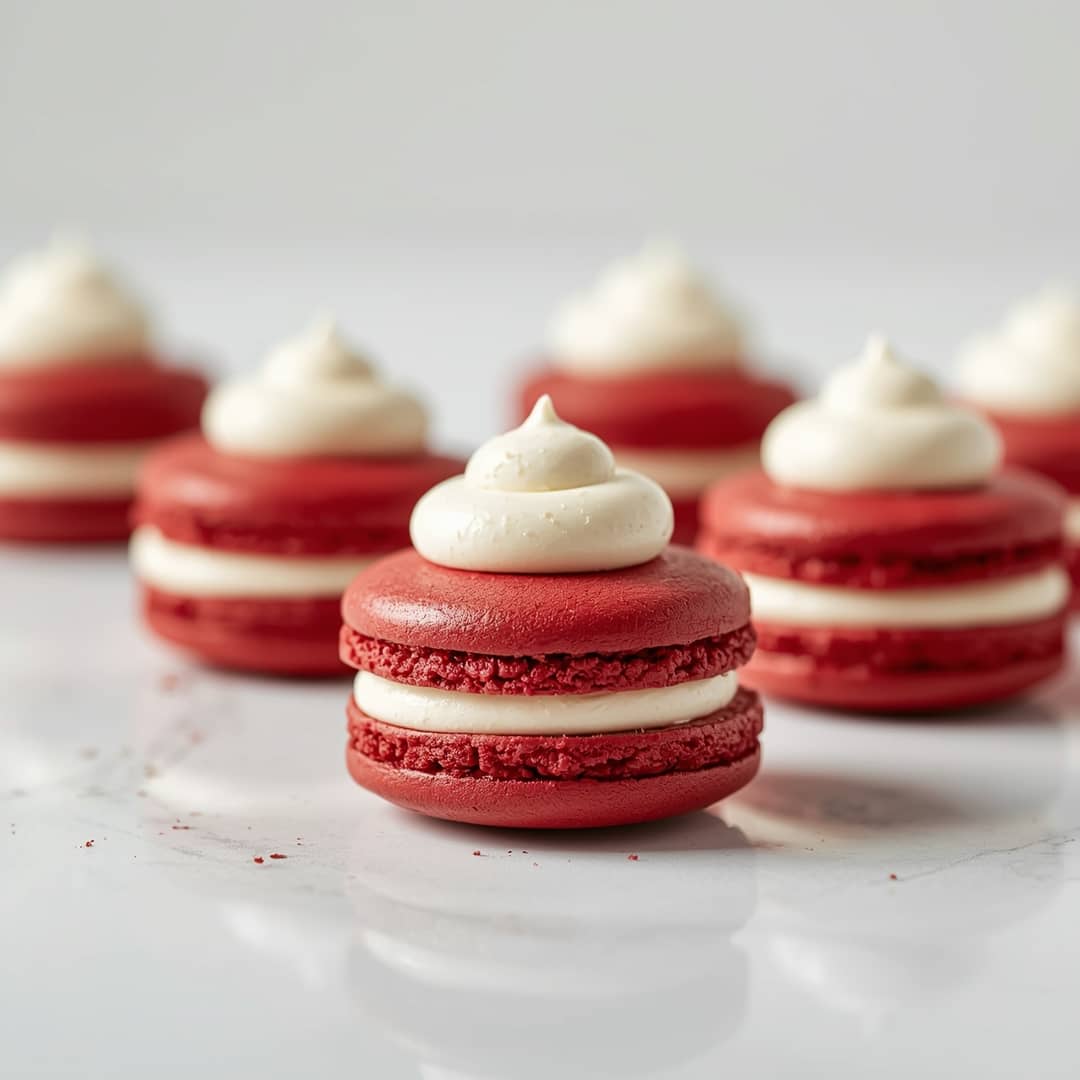
Red Velvet Macarons with Mascarpone Frosting
Ingredients
Equipment
Method
- In a medium bowl, whisk together the sifted almond flour, sifted confectioners’ sugar, and unsweetened cocoa powder. Sift this mixture a second time through a fine-mesh sieve into another clean bowl, ensuring no lumps remain. This is a crucial step for smooth macaron shells. You can use a whisk or even your fingers to break up any stubborn clumps. Discard any almond flour or sugar that doesn’t pass through the sieve.100 g almond flour, 100 g confectioners’ sugar, 1 tablespoon unsweetened cocoa powder
- In a clean, grease-free bowl of a stand mixer fitted with the whisk attachment (or using a hand mixer), begin whipping the aged egg whites on medium speed. Once they start to become foamy, add the white vinegar or cream of tartar. Continue whipping until soft peaks form – the egg whites will start to hold their shape but will curl over at the tip.75 g egg whites, 0.25 teaspoon white vinegar
- Gradually add the granulated sugar, a tablespoon at a time, to the whipping egg whites. Increase the mixer speed to medium-high and continue to whip until stiff, glossy peaks form. The meringue should be very firm, and when you lift the whisk, the peaks should stand straight up without drooping. This process can take 5-8 minutes.25 g granulated sugar
- Gently fold in the red food coloring gel or powder into the stiff meringue until evenly incorporated and a vibrant red color is achieved. Be careful not to overmix at this stage.1.5 teaspoons red food coloring gel
- Add about one-third of the sifted dry ingredients to the meringue. Using a spatula, gently fold the dry ingredients into the meringue using a ‘cut and fold’ motion. Scrape down the sides of the bowl and fold from the bottom up. Continue adding the remaining dry ingredients in two more additions, folding after each until just combined. You are looking for the batter to reach the “lava-like” consistency. When you lift the spatula, the batter should flow down in a thick, ribbon-like stream that slowly melts back into itself. If the batter is too stiff, it will not spread properly; if it’s too thin, the macarons will spread too much and have no feet. This is the most critical part of macaron making, known as macaronage. Precise folding is key to success.
- Transfer the macaron batter into a piping bag fitted with a round ½-inch tip. Line two baking sheets with parchment paper or silicone baking mats. Pipe small, uniform circles of batter onto the prepared baking sheets, leaving about 1-inch space between each piped circle. Aim for consistent size for even baking.
- Firmly tap each baking sheet on the counter several times. This helps to release any air bubbles trapped in the batter and encourages the shells to spread evenly. Let the piped macarons rest at room temperature for 30-60 minutes, or until a skin has formed on the surface. You should be able to gently touch the surface without the batter sticking to your finger. This resting period is vital for developing the characteristic “feet” of the macaron.
- Preheat your oven to 300°F (150°C). Bake one tray of macarons at a time for 15-18 minutes, or until the tops are firm and the feet have risen. The macarons should be slightly firm to the touch and should not wobble on their feet. They should lift cleanly off the parchment paper or mat.
- Once baked, remove the baking sheet from the oven and let the macarons cool on the sheet for about 5-10 minutes before carefully transferring them to a wire rack to cool completely. Ensure they are completely cool before filling.
- In a medium bowl, beat together the softened unsalted butter and softened mascarpone cheese until light and fluffy.100 g unsalted butter, 200 g mascarpone cheese
- Gradually add the sifted confectioners’ sugar, beating until well combined and smooth. Stir in the vanilla extract.150 g confectioners’ sugar, 1 teaspoon vanilla extract
- If the frosting is too thick, add milk, one tablespoon at a time, until it reaches your desired piping consistency. If it’s too thin, add a little more sifted confectioners’ sugar.150 g confectioners’ sugar, 1-2 tablespoons milk
- Once the macaron shells are completely cool, pair them up by size.
- Transfer the mascarpone frosting to a piping bag fitted with a round tip. Pipe a swirl of frosting onto the flat side of one macaron shell. Gently place the matching macaron shell on top and lightly press to sandwich.
- Place the filled macarons in an airtight container and refrigerate for at least 24 hours before serving. This “maturing” period allows the flavors to meld and the shells to soften slightly, creating the perfect chewy texture.